
Professional artists have used this trick for centuries: when a drawing feels “off” but you can’t say why, hold it up to a mirror. The flipped image breaks the familiarity your eyes have built up over an hour of staring at the page, and suddenly every crooked eye, leaning building, and lopsided face jumps out. Digital artists press the flip-canvas shortcut compulsively for exactly this reason and if you work on paper, flipping a photo of your sketch does the same job in seconds.
Here’s why the trick works, and how to build it into a simple drawing practice even if you’ve never considered yourself someone who can draw.
Why your brain stops seeing mistakes
As you work on a drawing, your brain gradually swaps the actual image for its idea of the image. Proportion errors get “autocorrected” by perception you see what you intended, not what’s on the page. Mirroring the image forces your visual system to process it as something new, and the autocorrect drops away. It’s the same reason writers proofread by reading backwards: familiarity hides flaws, and any transformation that breaks familiarity reveals them.
The mirror test is most dramatic on faces and symmetrical subjects. A portrait that looked fine for two hours can look almost comically skewed the moment it’s flipped which stings, but it stings early enough to fix.
A simple practice loop built around flipping
1. Draw one small thing. Ten to fifteen minutes, one subject, nothing precious. Deciding what to draw is the obstacle and for most people it genuinely is picking something from DrawingIdeas.net, a free library of more than a thousand drawing ideas with step-by-step picture guides, so you can go from “I should practice” to actually drawing in under a minute.
2. Photograph and flip it. Snap the sketch with your phone and mirror the image horizontally. Any image flipping tool does this in one click no editing skills required.
3. Note the two biggest problems. Don’t fix everything. The flipped view will usually make two errors obvious: a tilted axis, one feature larger than its twin. Write them down.
4. Redraw with those two fixes. The second version, informed by the flip, is almost always dramatically better. This before-and-after pair is also weirdly satisfying to keep it’s visible proof of improvement inside a single session.
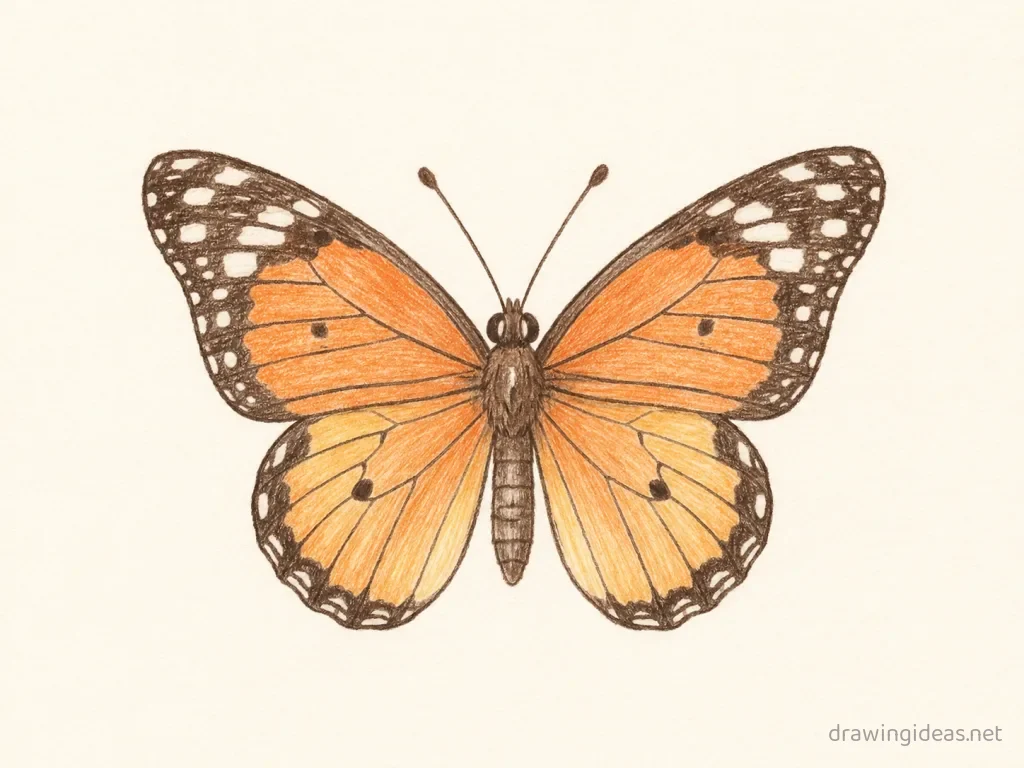
Symmetry subjects: the best flip training
Subjects with natural symmetry butterflies, faces, vases, mandalas are the perfect gym for this exercise, because mirroring immediately exposes any imbalance between the two halves. Start with a butterfly: draw both wings as identically as you can, flip the photo, and see how close you really got. Most beginners find their “identical” wings differ by 20 percent or more the first time. Within a couple of weeks of flip-checking, that gap shrinks visibly and the skill transfers to everything else you draw.
If you’re starting from zero, begin with subjects that are forgiving by design simple shapes, step-by-step builds like the beginner drawing ideas collection on DrawingIdeas.net, where every subject comes with a picture guide showing each stage.
The takeaway
You don’t need talent to improve at drawing; you need feedback, and the flip trick is the fastest free feedback loop there is. Draw small, flip the photo, fix the two worst things, repeat. Your tenth flipped drawing will embarrass your first one and that’s exactly the point.